
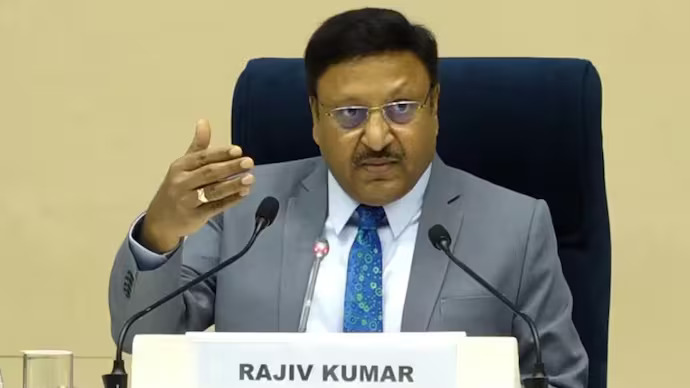
India’s largest private sector lender, HDFC Bank, has approved the appointment of former Finance Secretary and former Chief Election Commissioner Rajiv Kumar as its new Chairman, subject to approval from the Reserve Bank of India (RBI).
The appointment marks a significant leadership change at HDFC Bank following the resignation of former Chairman Atanu Chakraborty earlier this year.
HDFC Bank Board Approves Rajiv Kumar’s Appointment
According to a regulatory filing, HDFC Bank’s board has approved Rajiv Kumar’s appointment as an Independent Director for a four-year term beginning June 30, 2026.
The board has also recommended his appointment as Part-Time Chairman for a period of three years. However, the appointment will become effective only after receiving approval from the RBI.
Kumar succeeds Atanu Chakraborty, who stepped down from the position in March 2026.
Who Is Rajiv Kumar?
Rajiv Kumar is a senior retired civil servant with extensive experience in India’s financial and administrative sectors.
Before becoming the 25th Chief Election Commissioner of India, he served as Secretary of the Department of Financial Services between 2017 and 2020. During this period, India’s banking sector was facing several challenges, including rising non-performing assets (NPAs), capital shortages, governance issues, and financial fraud concerns.
His tenure is widely associated with major reforms that helped strengthen the country’s banking system and improve the financial health of public sector banks.
Key Banking Reforms Led by Rajiv Kumar
During his time at the Department of Financial Services, Rajiv Kumar played a central role in implementing measures aimed at improving transparency and accountability in the banking sector.
Some of the major initiatives included:
- Strengthening recognition and resolution of bad loans (NPAs)
- Improving capital adequacy of public sector banks
- Enhancing borrower accountability through the Insolvency and Bankruptcy Code (IBC)
- Tightening oversight of cooperative banks
- Strengthening fraud monitoring systems
- Promoting technology-based risk assessment in lending
These reforms were carried out under the government’s “4R Strategy”:
1. Recognition: Ensuring banks accurately identified stressed assets and bad loans.
2. Resolution: Accelerating recovery and resolution of non-performing assets.
3. Recapitalisation: Providing financial support to strengthen bank balance sheets.
4. Reforms: Improving governance standards and operational efficiency across banks.
Public Sector Bank Consolidation Under Rajiv Kumar
One of the most significant developments during Kumar’s tenure was the consolidation of public sector banks.
The government merged 27 public sector banks into 12 larger and stronger institutions. The move aimed to improve efficiency, strengthen balance sheets, and enhance competitiveness within the banking industry.
Regional Rural Banks (RRBs) also underwent restructuring through a “One State, One RRB” approach to improve operational effectiveness.
Measures to Combat Financial Fraud
Rajiv Kumar’s tenure also witnessed several steps to curb financial misconduct and improve regulatory oversight. Authorities froze accounts linked to more than 3 lakh suspected shell companies as part of efforts to tackle illicit financial activities.
The government also introduced stronger regulations against unregulated deposit schemes through the implementation of the Banning of Unregulated Deposit Schemes Act, 2019.
Additionally, stricter monitoring systems were introduced for large loans, and advanced risk assessment tools were deployed to strengthen lending practices.
Focus on Depositor Protection
A major milestone during Kumar’s tenure was the increase in deposit insurance coverage. The insurance limit available to bank depositors was raised from ₹1 lakh to ₹5 lakh, providing greater protection and confidence to millions of account holders across the country.
What Rajiv Kumar’s Appointment Means for HDFC Bank
Rajiv Kumar brings decades of experience in financial sector reforms, governance, risk management, and public administration.
His appointment is expected to strengthen HDFC Bank’s leadership structure and support the bank’s long-term growth strategy. With deep expertise in banking reforms and financial regulation, Kumar is likely to play an important role in guiding the bank through an evolving economic and regulatory environment. The final appointment will take effect after the Reserve Bank of India grants its approval.